Safety
You are letting a stranger into your mother's house.
That is the actual decision, and no amount of warm photography answers it. This page is the specific list of what we check, what the apps verify, who can see what, and what happens when a visit goes wrong.
Before anyone visits
Four things, and a companion who is missing one doesn't get offers.
Identity, against government ID
A face check against a government photo ID. Everything else rests on this: a record check is only worth something if it belongs to the person at the door.
A vulnerable-sector record check
Appropriate to working with older adults, not a generic background screen. We hold the result and the date it was issued.
References we actually call
Two of them, spoken to by a person. It is the step most likely to surface something a database won't.
Requirements that expire
First aid and the record check both have dates. When one lapses the companion stops receiving offers automatically — nobody has to remember to switch them off.
During the visit
Evidence, rather than everyone's word for it.
The difference between a marketplace that says visits happened and one that can show it.
Arrival is corroborated, not claimed
Check-in needs location plus a PIN your parent or you hold. A companion cannot mark themselves present from the car park. There is a supported manual path for poor GPS or a senior who can't enter a code — it just isn't the silent default.
The companion sees the least they need
Home access details and risk notes appear only while they're assigned to that visit, and only for that purpose. The exact address arrives after acceptance, near the visit time.
Incidents capture without a signal
A concern or an emergency can be recorded with no mobile data, held in a durable queue on the device, and uploaded when there's a connection. Poor reception is not a reason a record goes missing.
A serious incident stops the money
It pauses the charge to your card and the companion's payout, both, until a person has reviewed it. Checkout cannot close over an unresolved incident.
When help is needed
Help is a phone call, not a conversation with a chatbot.
The Help control sits on every screen of the senior app, in the easiest place to reach.
It doesn't ask an open-ended question
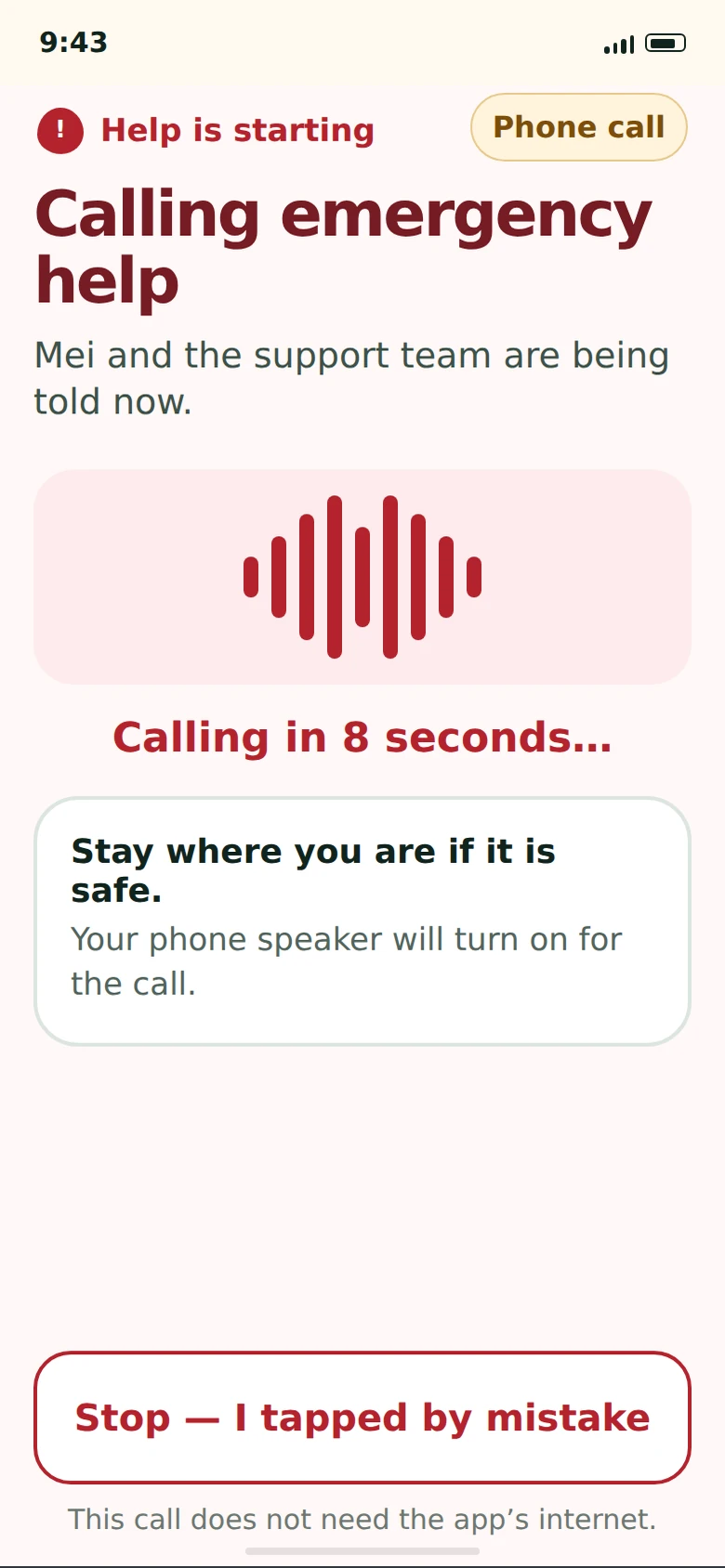
Pressing it starts a deterministic sequence: a call, and an alert to the care circle. It never routes a frightened person into a language model to find out what they meant.
It works when the internet doesn't
The call runs over the ordinary telephone network, so a dropped connection or an expired data plan doesn't take emergency help with it. Emergency words are also recognised on the device itself.
A mistaken tap is easy to undo
There's a visible countdown and a large cancel control, because the alternative is an older person who becomes afraid to touch the button at all.
The family alert says what is known
What happened, what the system has already done, and the next human action. It never offers a diagnosis.
Consent and privacy
Your parent is an adult, and the software treats them like one.
The failure mode of family care software is that it quietly becomes surveillance of the person it was meant to help. These are the decisions that stop that here.
Access is granted by purpose, and expires
A sibling who needs to see visit summaries doesn't automatically get emergency alerts or location. Each is a separate grant with its own expiry, set by your parent.
There is no household feed
We do not stream a camera, a microphone, or a continuous location trace of an adult's home to their children. You see visits and what came out of them, not a surveillance product.
The report is the consented one
A companion's private safeguarding notes are never family-visible. What you receive is what your parent agreed you'd receive.
AI drafts, people confirm
Voice input and dictated summaries are labelled as drafts and cannot act or submit on their own. No call is placed, no account changed, and no report sent without a person confirming it.